
Before the Sox Decide, Bridgeport Should
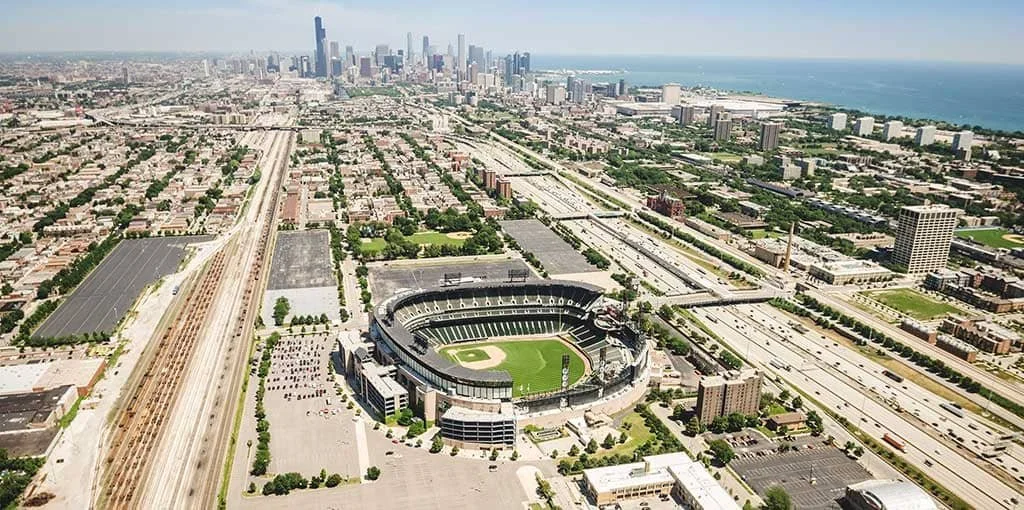
Stand outside Rate Field on a non-game day and you'll see the real footprint of the ballpark: not the stadium itself, but the acres of flat, fenced, empty asphalt that surround it. Lots B, F, L, each one a rectangle of nothing, waiting for eighty-one nights a year to matter. The rest of the time, it's just a void in the middle of one of Chicago's oldest neighborhoods.
That void is now a live question. Justin Ishbia's Canal Edge has floated The Railyards, a riverfront stadium and mixed-use megadevelopment on Amtrak's 14th Street Coach Yard in the South Loop, directly across from The 78. The proposal is still early, a feasibility study, not a set plan, and the White Sox's lease at Rate Field runs through 2029. But regardless of whether the team ever plays a game in the South Loop, Bridgeport is left holding a question it should have been asking for decades: what does this site want to be when it isn't a parking lot?
Here's what makes that question worth taking seriously: Bridgeport already has the hard part solved. The Sox-35th Red Line stop sits practically on top of the ballpark gate, a two-to-three-minute walk from platform to turnstile, closer than almost any other stadium-to-transit connection in Major League Baseball. The Rock Island Metra line stops one block away. This is not a site starved for infrastructure. It's a site starved for reasons to use that infrastructure on the other 284 days a year.
Compare it to what happened around Wrigley Field. When the Ricketts family took over the Cubs, they didn't just renovate the ballpark. They took a parking lot next door and turned it into Gallagher Way, a mix of retail, office, and open space designed explicitly to keep the neighborhood alive on non-game days. Down the street, Addison & Clark stacked 148 residential units and 150,000 square feet of retail on what used to be more asphalt. None of that worked because Wrigleyville has some magic Bridgeport lacks. It worked because somebody decided the land next to a ballpark was worth more as a neighborhood than as a lot.
Bridgeport has the same bones, arguably better transit, and none of that investment. Rate Field's parking sprawl was built for a different era of baseball, the drive-park-watch-leave model instead of the walk-through-the-neighborhood model. Thirty-five years later, that model is showing its age architecturally as much as economically. The lots aren't an asset sitting idle. They're a cost: acres of tax-generating, job-producing, street-life-producing urban land, functioning as nothing.
What could go there instead isn't complicated, architecturally speaking. Ground-floor storefronts for local vendors, restaurants, and shops, with residential or hotel density stacked above, a commercial spine along 35th Street that gives the Red Line stop a reason to see foot traffic on a Tuesday afternoon, not just before first pitch. Bridgeport doesn't need a stadium to justify that. It needs the same civic imagination Wrigleyville got, applied to a site that's honestly better connected.
None of this resolves the larger fight over whether the Sox should leave Bridgeport at all, and I'm not going to pretend that's a small question. A neighborhood watching a 116-year relationship with its team come apart deserves more than a design essay's worth of consideration. But the parking lots don't wait for that fight to resolve. They're sitting there right now, one block from a train stop, doing nothing.
So the real question for Bridgeport isn't only "how do we save the stadium." It's: if the last thirty-five years turned this land into parking, what do the next thirty-five turn it into, and who gets to decide that before someone else does?
