
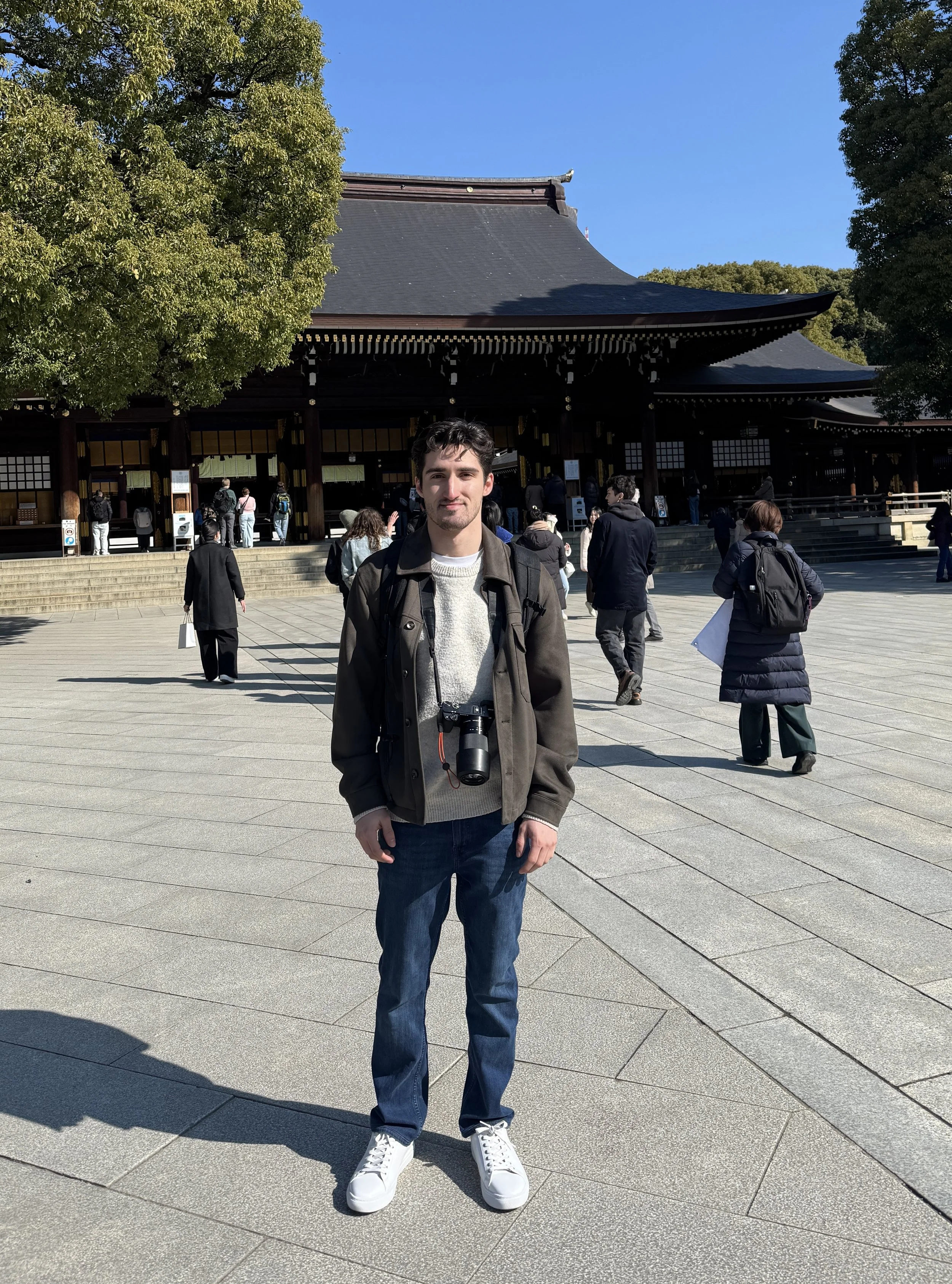
Meiji Shrine, Shinto shrine in Shibuya, Tokyo.
Tokyo & Kyoto, March 2026 — Tomodachi Kakeashi Scholar
I went to Japan expecting Tokyo to hit like New York. The density, the noise, the particular electricity of a city that never quite lets you exhale. I packed for overwhelm.
What I found instead was a city that had figured out something most cities haven't. That density doesn't have to be aggressive. That ten million people sharing a subway platform can, somehow, be quiet.
That quietness unsettled me more than the chaos I'd prepared for.
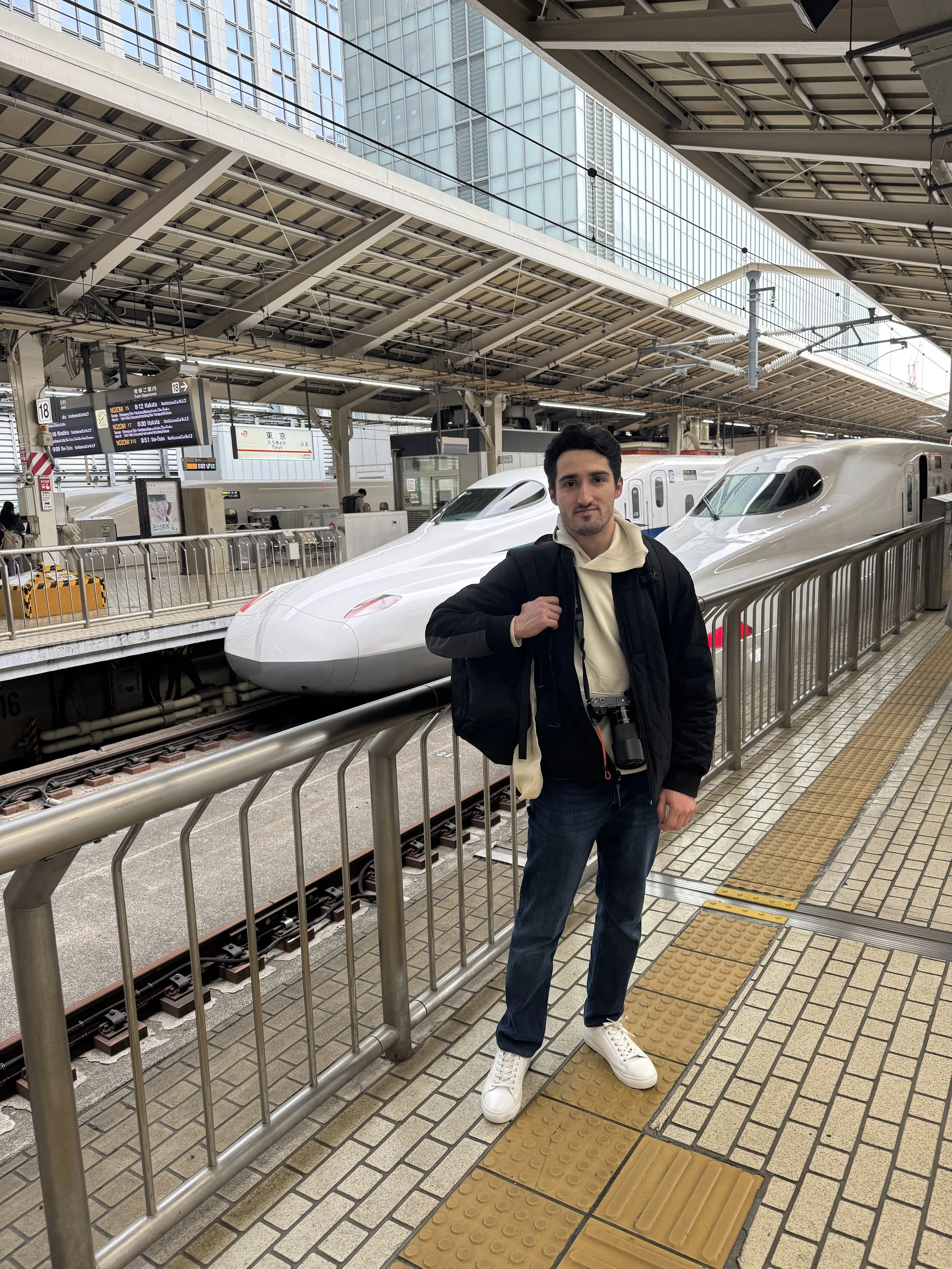
Bullet train!
The city as instructor
Architecture school trains you to read a city before you experience it. You arrive with references already loaded — Piano, Viñoly, Katsura, the woodblock prints, the metabolism movement — and for the first day or two you move through space like you're checking things off. Then something slips through the framework and you have to put the references down.
For me it was the subway. Rush hour in Tokyo, train cars packed, the whole system moving millions of people through the earth at once. And silence. Not the silence of emptiness but the silence of agreement — a collective understanding of shared space so internalized it doesn't need a sign, a rule, an announcement. People stood without spilling into each other. Music stayed in headphones. The city moved, and breathed, and held itself together with a composure that no American city I know has managed, including the ones that spend a great deal of money trying.
I kept asking myself: who designed this? And kept arriving at the same answer. Nobody. Everybody.
The streets were the same — immaculate in a way that felt less like maintenance and more like intention. There are almost no public trash cans in Japan, which should produce the opposite result and doesn't. What keeps the streets clean isn't infrastructure. It's a shared sense of responsibility for the spaces we move through together. You can't mandate that. You can't blueprint it. But you can build a city that makes people feel like the space belongs to them, and watch what happens when they do.
Glass, wood, and what light does to both
The Maison Hermès on Ginza stopped me before I even knew it was going to. Piano's glass block facade is a lesson in restraint as seduction — light passes through, image doesn't. You sense something interior and alive without being able to fully see it. There's a generosity in that withholding, an architectural tact. The building trusts you to be curious. It doesn't perform for you.
Viñoly's Tokyo International Forum performs, and earns every note of it. The atrium arches over you like the hull of a ship from another civilization, and what surprises you isn't the scale — it's what the scale is in service of. People eat lunch there. Students read. It functions as a civic room, a public living room dropped into the heart of one of the world's most pressurized transit hubs. Some large buildings make you feel small. This one makes you feel welcome.
On the bullet train between cities I sketched from photographs — trying to slow down what I'd seen, to hold detail before the next wave arrived. The Shinkansen runs to the second. Platforms are marked for exactly where each car door will stop. The whole system is a design argument: that moving through a city should feel like being cared for, not processed.
Katsura and the art of earning a view
Katsura Imperial Villa doesn't announce itself. That is the point and the lesson.
The paths curve. The garden reveals itself in sequence, each view arriving only after you've moved through enough space to deserve it. The buildings are not grand — they are precise, in the way a well-placed word is precise, in the way silence after music is precise. I moved through it slowly without deciding to slow down. The space made the decision for me.
This is what the great Japanese spaces understand that so much Western architecture forgets: restraint is not the absence of intention. It is intention at its most concentrated.
Todai-ji I experiencing the Great Buddha Hall, one of the largest wooden structures ever built, raised in the 8th century with the tools of the 8th century, and it is still here. Still standing. American architecture rarely asks you to think across that kind of time. We haven't been building long enough to know yet what lasts.
What the students showed me
The Tomodachi program brought us together with architecture students from Nara Women's University. They walked us through their campus and through Todai-ji, sharing their work, asking about ours, bridging whatever gap existed between two groups of young architects from opposite sides of the world with the only language that was always mutual — the love of space, of why things are built the way they are, of what a building asks of the person standing inside it.
Their excitement was genuine and it was generative. No stiffness, no performance. Just curiosity meeting curiosity. I've had studio critiques that communicated less.
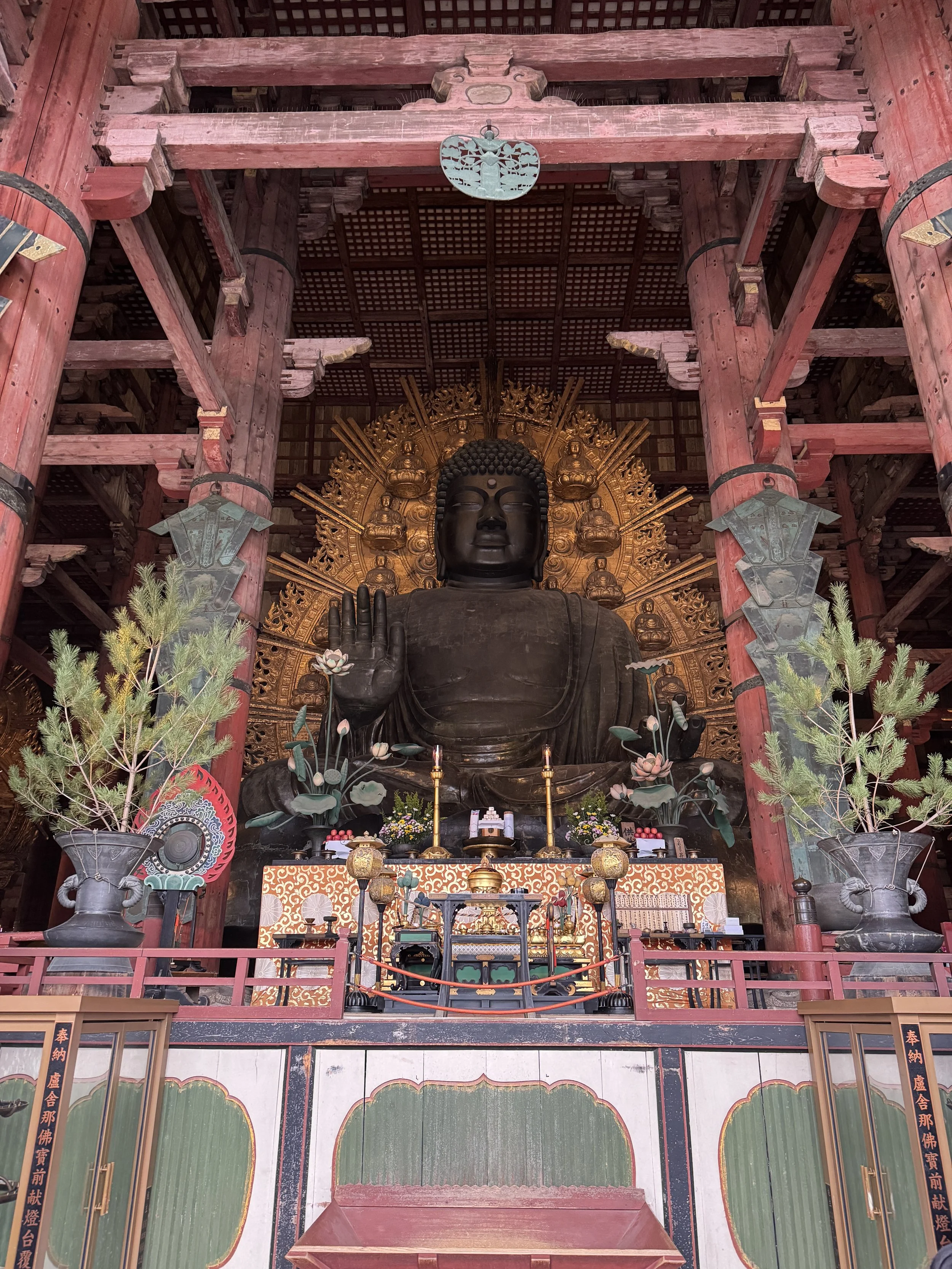
Great Buddha at Todai-ji.
A kitchen in Kyoto
My host family taught me to make takoyaki. They took me to conveyor belt sushi. One evening they taught me origami, folding cranes with a patience and care that seemed to characterize everything they did.
We didn't share a language. We shared a kitchen, a table, an hour of folding paper, a slow morning walk. Food arrived and we ate it. Laughter happened and we laughed. Something passed between us that didn't need translation because it predates language — the simple animal warmth of people choosing to sit together and be present with each other.
I kept thinking about what made that possible. It wasn't the conversation. It was the room. The low table. The griddle at the center. The space arranged so that everyone was facing each other, close enough that silence wasn't awkward, it was comfortable. Someone had designed those conditions without designing the connection itself. The connection just came, the way it does when you give it room.
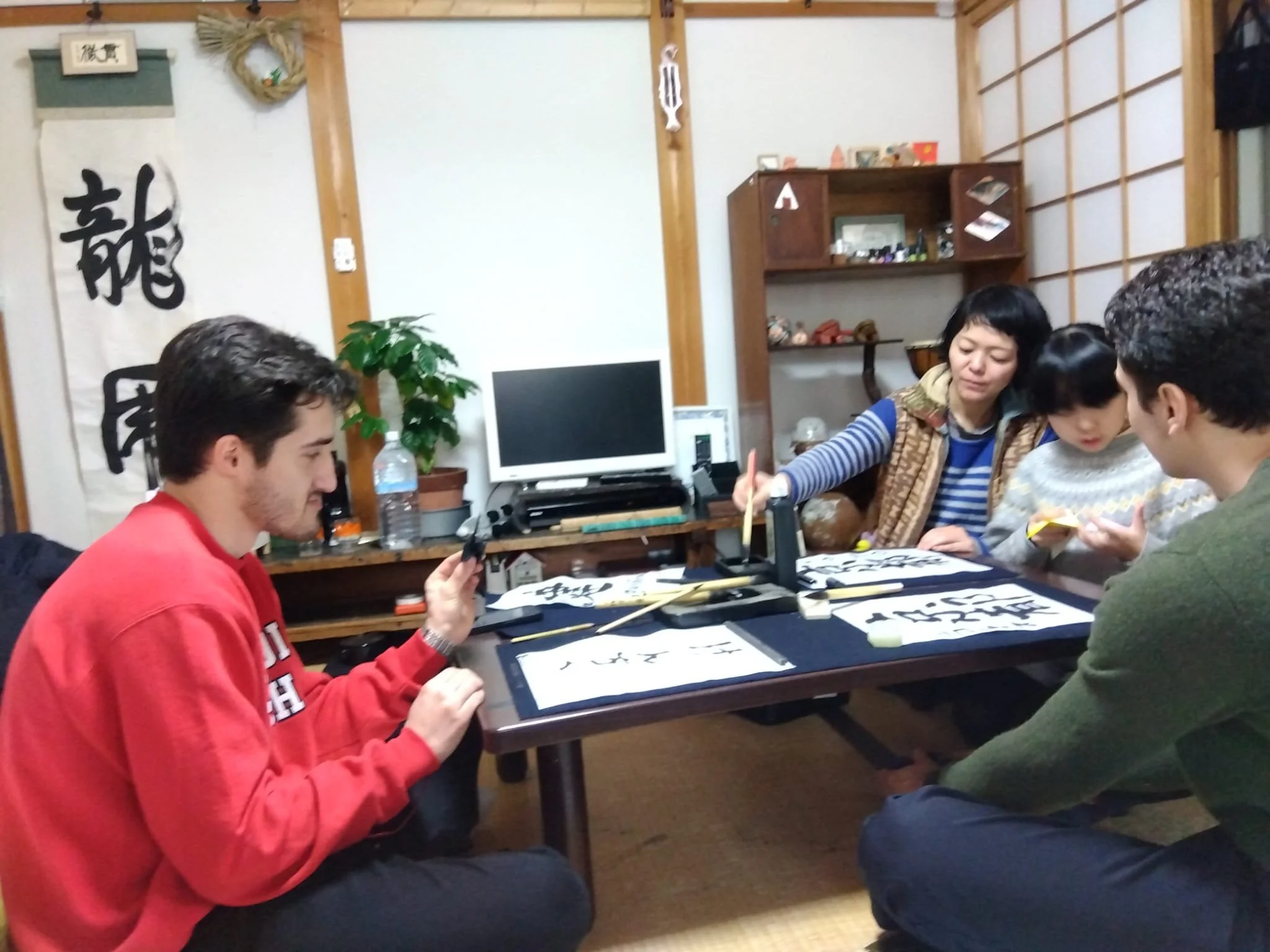
Learning calligraphy with our host family in Kyoto.
The thing I couldn't stop thinking about
Culture isn't something you can design. You cannot draft a blueprint for collective care, for civic pride, for the instinct to fold your litter and carry it home. Japan made this clear in every quiet, humbling way — on the subway, on the street, in the immaculate spaces between buildings where in another country there would be graffiti and litter.
But you can design the spaces where culture prospers. You can build a transit system that signals to every rider that they are worth the precision. You can arrange a kitchen so that strangers become less strange. You can curve a garden path so that arrival feels earned. You can stack glass blocks so that light passes through and draws people toward something they can sense but not quite see.
That is what Japan gave me — not a set of answers but a sharper version of the question I want to spend my career asking. What does a space make possible? What does it invite? What does it hold?
The sketchbook came back full. The work of understanding what's in it has barely begun.
This trip was made possible through the Tomodachi Kakeashi Scholarship program, supporting U.S.-Japan exchange and emerging leadership.
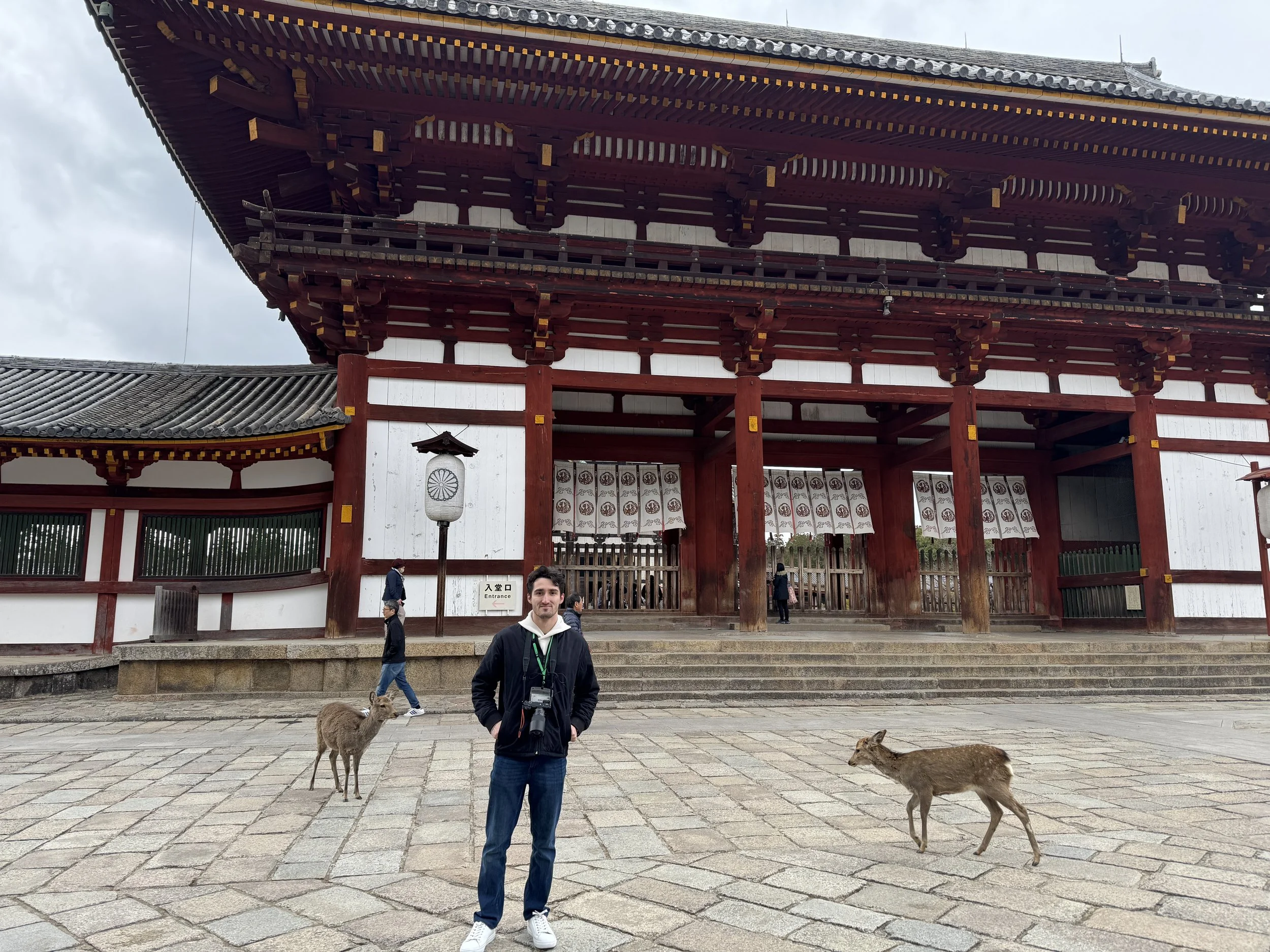
Could someone identify these photo bombers?
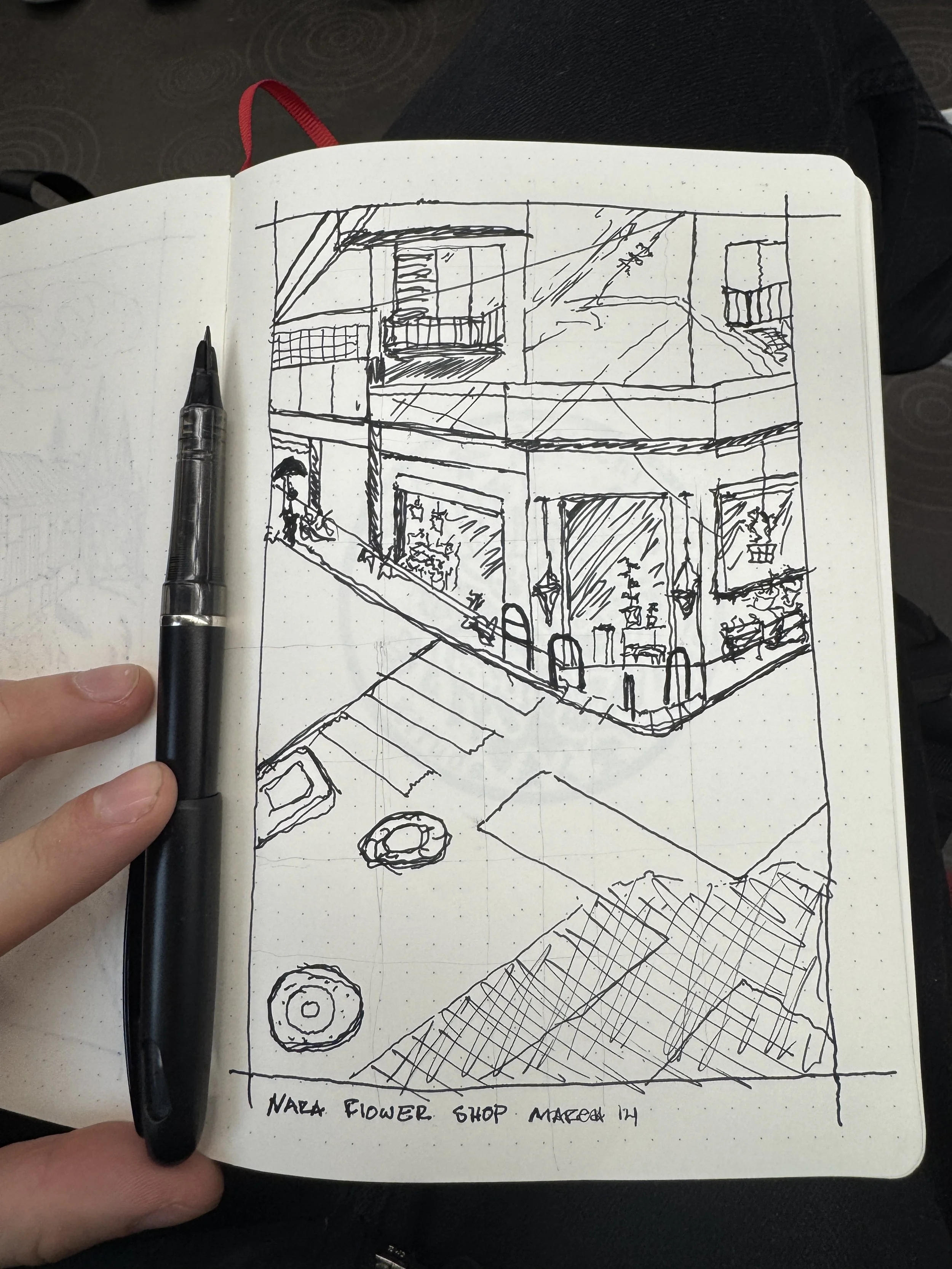
Sketch of a Flower/Plant Shop in Kyoto.
